Nobody enjoys checking their portfolio every single day, and honestly, the people who do usually make worse decisions because of it. The whole point of good long-term investment options is that you set them up once, stay consistent, and mostly leave them alone.
Here’s what actually holds up over a decade or more.
Equity Mutual Funds Through SIPs
Systematic Investment Plans in equity mutual funds remain one of the most reliable long-term investment options, especially for people who don’t want to actively manage a stock portfolio.
A ₹10,000 monthly SIP over 15 years, assuming a modest 11-12% average annual return, can grow into a substantial corpus purely through consistency and compounding — no market-timing skill required.
- Choose index funds for low cost, steady market-matching returns
- Choose flexi-cap or multi-cap for slightly more active management
- Stay invested through market dips instead of pausing SIPs out of fear
Public Provident Fund (PPF)
PPF remains criminally underrated. It’s government-backed, offers tax-free returns, and the current interest rate (revised quarterly, generally 7-7.5%) is genuinely solid for a risk-free instrument. The 15-year lock-in feels long, but that’s exactly what makes it a true long-term play.
National Pension System (NPS)
NPS combines equity and debt exposure with additional tax benefits under Section 80CCD(1B), beyond the usual 80C limit. It’s specifically built for retirement, so withdrawal is restricted till 60 — which, frankly, is a feature, not a bug, for anyone tempted to dip into savings early.
Direct Equity for the Patient Investor
Picking individual stocks and holding for 10+ years has created enormous wealth for disciplined investors — think of anyone who held onto strong compounders through multiple market cycles. But this route demands real research and, more importantly, emotional discipline during downturns.
Direct equity can outperform mutual funds over the long run, but only for investors willing to research thoroughly and hold through volatility without panic-selling.
Real Estate — Slow but Tangible
Real estate rewards patience more than almost anything else on this list. It’s illiquid, transaction costs are high, but property in growing cities has historically appreciated well over 10-15 year horizons. It’s not for everyone — capital requirements are steep — but it adds a tangible asset to a portfolio otherwise full of paper investments.
Gold — The Quiet Long-Term Hedge
Gold rarely gives spectacular short-term returns, but over 15-20 year stretches, it’s protected wealth against inflation and currency depreciation reliably. Digital gold, Sovereign Gold Bonds, or gold ETFs make this far easier than storing physical gold today.
Comparing the Options at a Glance
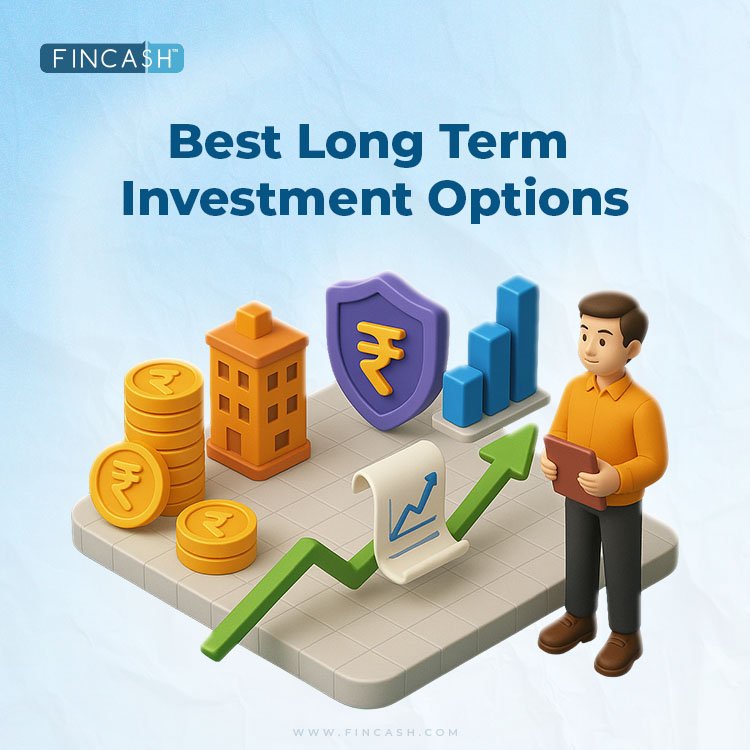
- Equity SIPs — highest growth potential, moderate to high risk
- PPF — safest, tax-free, but capped returns
- NPS — retirement-focused, tax-efficient
- Direct equity — highest potential, highest effort/risk
- Real estate — tangible, illiquid, capital-intensive
- Gold — inflation hedge, modest steady growth
[link to related guide about SIP vs lump sum investment here]
FAQs
What’s the safest long-term investment option? PPF and other government-backed schemes are considered among the safest, though returns are naturally more modest.
Can I combine multiple long-term options together? Yes, and most financial planners recommend exactly that — spreading across equity, debt, and gold rather than relying on just one.
Is real estate still a good long-term option in 2026? It can be, particularly in growing tier-2 cities, but requires larger capital and patience with lower liquidity.
How long counts as “long-term” for investments? Generally 7-10 years or more, especially for equity-linked instruments, to smooth out market volatility.
Should I stop my SIP during a market crash? Usually not — market dips are actually when SIPs buy more units at lower prices, benefiting long-term returns.
Conclusion
There’s no single “best” long-term investment option — the right mix depends on your goals, risk appetite, and how many years you actually have before you’ll need the money. Start with whichever option fits your comfort level today, even a small amount, and let time do the heavy lifting from there.
Suggested image alt text: “graph showing long-term investment growth over 15 years”